Map of Land Grants in Davie County, North Carolina
http://www.pastseeker.com/boone/misc/yadkin-main.shtml
Date of access to this map was 16 January 2003
Entry of land plat for John Lankford dated 1790
Land is situated southeast of Mocksville, the county seat and between two large creeks. These may be Rockie Creek and Peelers Creek. Print is very light and hard for me to read.
Davie County formed in 1836 from Rowan County is bordered by Rowan, Iredell, Yadkin, Forsyth and Davidson counties. For earlier documents search Rowan County records.
Saturday, June 30, 2007
Warren County North Carolina Deeds
Warren County Deed Books
Volume 11, 1790-1791 page 72,
August 24, 1786: George Langford to William Bartlett; 37 acres recorded 3 December 1790. Samuel (x) Bartlett, witness.
Volume 13, 1792-1796, page 319
George Langford to Samuel Bartlett, for 46 pounds, 46 acres on William and Samuel Bartlett's lines to John Clark's to Smith's Creek, Recorded 1 February 1796.
Volume 11, 1790-1791 page 72,
August 24, 1786: George Langford to William Bartlett; 37 acres recorded 3 December 1790. Samuel (x) Bartlett, witness.
Volume 13, 1792-1796, page 319
George Langford to Samuel Bartlett, for 46 pounds, 46 acres on William and Samuel Bartlett's lines to John Clark's to Smith's Creek, Recorded 1 February 1796.


Bath County North Carolina
William L. Saunders, Secretary of State, collector and editor, Colonial Records of North Carolina, Vol. II 1713 - 1728, published 1886, 547 - 548
Extract:
Case against Mary Cotton, spinster, on 20th day of November 1723, in Bath Town in County of Bath in province of North Carolina, found guilty of petty larceny of goods the property of Roger Kenyon. On the Petition of Elizabeth Langford, Eleanor Clarke, Edward Harrington and Martha Morris for attendance and as evidences for the King it is order that Mary Cotton pay for three days attendance at half of crown per day for four days for travelling at 20 pence per day and 10 shilling ferrying each in all 24 shilling and 2 pence each.
Extract:
Case against Mary Cotton, spinster, on 20th day of November 1723, in Bath Town in County of Bath in province of North Carolina, found guilty of petty larceny of goods the property of Roger Kenyon. On the Petition of Elizabeth Langford, Eleanor Clarke, Edward Harrington and Martha Morris for attendance and as evidences for the King it is order that Mary Cotton pay for three days attendance at half of crown per day for four days for travelling at 20 pence per day and 10 shilling ferrying each in all 24 shilling and 2 pence each.
Monday, June 18, 2007
War of 1812 Records at National Archives
Winter 1991, Vol. 23, No. 4
Genealogical Records of the War of 1812By Stuart L. Butler
National Archives records created during and after the War of 1812 offer the genealogist a diverse and fertile ground in which to obtain invaluable family information.1 These records were created by a variety of government agencies to include various bureaus and offices of the War of 1812, Interior, and State departments in response to specific federal laws. Most Department, particularly those generated by the Adjutant General's Office (Record Group 94). The records are now serviced by the General Reference Branch and the Military Reference Branch of the Textual Reference Division. Unlike many records of genealogical value from the Revolutionary - era records in the National Archives having genealogical value were created by the War War era, similar records for the War of 1812 period have not been microfilmed and are not available through interlibrary loan. The notable exceptions are a number of name indexes for the compiled military service records and pension application files.2
Pension and Bounty Land Warrant Application Files
Perhaps the most genealogically rich records for this period are the pension application files in the records of the Veterans Administration (Record Group 15). There are two primary series of pension application files that relate to War of 1812 veterans. The first series ("Old Wars") consists of pensions to veterans of the army, navy, and Marine Corps based on service resulting in death or disability from the end of the Revolutionary War period up to the Civil War. The files include not only information about the veteran's service but also are likely to contain family information such as children's names and data about the widow's maiden name and marriage. The records are arranged alphabetically by veteran and can be accessed by using the name index that has been microfilmed as Old War Index to Pension Files (T316, 7 rolls). The index also indicates the veteran's name, unit, and state from which the claim was made, and type of claimant, whether widow, child, or other heir. Related records (YI), also arranged alphabetically, pertain to navy and Marine Corps veterans.
Pension application files for most War of 1812 veterans, however, will be found in the second series of pension files, i.e., those based on the acts of 1871 and 1878. These acts, based on length of service alone, relate mostly to militia veterans called to federal service. The 1871 act provided pensions to veterans who had served at least sixty days or to their widows if they had married before 1815. The 1878 act provided pensions to those veterans, or their widows, who only served fourteen days. By the time these acts were passed, most applicants were widows or minors rather than veterans themselves. A typical file usually contains the soldier's or widow's application file, a statement of service usually provided by the Pension Bureau, and other papers prepared by the Third Auditor's Office. Of the two, the widow's or minor's application is potentially the richest in genealogical information. This is because the widow had to provide proof of marriage, including the date or place of marriage, and usually the maiden name. Important data about marriages before 1815 found in some of the files may not be available anywhere else. Interfiled among these pensions in some cases are some bounty land application files. While the pension files are not on microfilm, an informative index showing much data has been microfilmed as Index to War of 1812 Pension Application Files (M313, 102 rolls). Supplementing the index is a remarried widow's card index, which covers the period 1816 - 1860. The alphabetically arranged index cards show the new remarried name of the veteran's widow and the former veteran's name.
Although the process is somewhat involved, it is sometimes possible for a researcher to determine when a pension payment was last paid to a veteran or his heir. Among Veterans Administration records are the field record books (1805 - 1912), which can be used to determine when pension payments were made and when they stopped. To extract such information, one must know under which act a veteran was entitled to receive a pension and the city where the agency was located paying the pensioner. The search can be time-consuming, but information indicating the pensioner's date and place of death could be the reward.
War of 1812 veterans, and later their widows and heirs, could also apply for bounty land under the act of May 6, 1812, and a variety of subsequent federal laws. Most veterans were entitled to 160 acres, but in a few cases some received 320 acres, called double-bounties. Until 1842, the land lay within the states of Illinois, Arkansas, and Missouri, and until 1852 the land was not transferable. A typical bounty land application warrant file contains the veteran's name, age, unit, residence, period of service, and if applicable, the widow's (or heir's) name, age, and place of residence. Applications for bounty land claimed under different legislative acts will be filed under a single veteran's name. In many cases, bounty application files from regular army, navy, and Marine Corps veterans consist only of a discharge certificate. These files are arranged alphabetically by name of veteran, but they are unindexed. Researchers of these files should search the pension files in addition to searching the more numerous bounty land files. Less informative are the actual bounty land warrants, which were not issued to the veteran or his heirs. They do show, however, where the land to which the veteran was entitled was located and the date and name of the person to whom the land was given. Since many veterans sold their rights to bounty land to other persons, their names do not appear on many of the warrants. The warrants have been filmed on War of 1812 Military Bounty Land Warrants, 1815 - 1858 (M848, 14 rolls).3
Military Service RecordsThe National Archives has some kind of military service record for most soldiers who served during the War of 1812. Genealogical information found in these records varies greatly depending on the type of service rendered. Naval service for enlisted men is more difficult to establish, especially when the soldier was an enlisted man. Establishing service for a Marine Corps soldier is somewhat easier.
Compiled Military Service Records. The great majority of soldiers who served during the War of 1812 were volunteers, or members of state militia who were federalized for portions of the war period. There were also volunteer units directly raised by the federal government. The service records of these soldiers consist of compiled military service records or those records of service that were compiled from the original muster and pay rolls by the clerks in the Adjutant General's Office after the war (Records of the Adjutant General's Office, Record Group 94). The records are arranged by state or federal volunteer unit and thereunder alphabetically by name of soldier. A microfilmed index to these records is available on Index to Compiled Service Records of Volunteer Soldiers who Served During the War of 1812 (M602, 234 rolls). The actual service records have not been filmed. The service records show the soldier's name, rank, regimental unit (usually showing the last name of the regimental commander), the company commander's name, dates of service and pay, whether the soldier was a substitute, date of discharge, and sometimes, distance to the soldier's home from place of discharge. Other information such as date of death, if applicable, and periods of sickness, if recorded on the muster rolls, is noted. The service record reflects the information found on the original muster and payrolls; all information from these original rolls has been transferred to the compiled service record, so there is no need to examine the original rolls to obtain additional information. Because so many volunteers served only a few days or weeks, the information available is frequently meager. These records will not ordinarily show place of birth, age, or parents' names. They may show, however, disciplinary action resulting in dismissal or court-martial, if such information was noted on the muster roll. Compiled service records for officers show much the same information but usually include original vouchers and receipts for supply, pay, and transportation. Some of these papers may enable a researcher to determine where a unit served during the war.4
Regular Army Enlistment Registers and Papers. If a soldier's name does not appear in the index for volunteer soldiers, he might have served in the regular army. If the soldier served as an officer in the U.S. Army during this period, his name should be in Francis B. Heitman's Historical Register and Dictionary of the U.S. Army (1903). There are no consolidated "service records" for officers before 1863. Aside from entries in Heitman, one can examine the correspondence of the Adjutant General's Office for pertinent documentation relating to these officers. Most of the names of regular army soldiers who served during the War of 1812 appear in the fifteen volumes of enlistment registers that show the names of soldiers enlisting for the period 1798 - 1815. Despite the dates indicated, most of the names in these registers are for those who enlisted during the War of 1812 period. The names are arranged alphabetically by the initial letter of surname, and thereunder alphabetically by given name, e.g., the name of Aaron Atkins would come before George Abbott, regardless of when each enlisted. The registers are somewhat more useful to the genealogist than the information provided on the compiled service record because they can show the age, place of birth (either city, county, or state), physical description (to include height), occupation, place and date of enlistment. The registers also indicate when, where, and under what circumstances the soldier was discharged. These registers were compiled in the late nineteenth century by the Adjutant General and are based on a variety of original records such as muster and payrolls, inspection and descriptive rolls, and other miscellaneous records in the Adjutant General's Office. As with the compiled service records, the information on these original records was transferred to the register, so no additional information is available from exarraning the original records. Fortunately for the researcher, these registers have been microfilmed on Registers of Enlistments in the U.S. Army, 1798 - 1914 (M233, 81 rolls). Another series of records, the enlistment papers, may also be useful. Unfortunately, the original enlistment papers for the War of 1812 period are fragmentary and incomplete. The papers are arranged alphabetically for the period 1798 - 1894. Much of the same information, however, can be found in the registers of enlistments.
Other Military Records. The Adjutant General's Office also includes several useful, but lesser known, series of records that may prove useful to the genealogist. The certificates of disability for the War of 1812 are documents signed by a surgeon attesting to the disability and discharge of regular army soldiers. Arranged by regiment and then by name, the certificates include information such as name, age, rank, unit, enlistment date, place of birth, and personal description. If no enlistment register entry exists for an individual, then this series might help. In addition to the large series of enlistment papers already discussed, a small series of enlistment papers and discharges also exists for the War of 1812 period. If no information is found in the larger series, then these papers should be examined. Often overlooked, but potentially useful, are Miscellaneous Manuscripts of the War of 1812 and its accompanying name index. The manuscripts contain a great variety of information about regulars, volunteers, and civilians. The records are arranged numerically and appear to be grouped by state and federal units. Among the records are vouchers, returns, receipts for supplies signed by officers in the field, and impressment of articles and services from civilians such as ferrymen, landlords, farmers, and seamstresses. The records appear to document mostly the activities of volunteer units and should be searched whenever the subject is a volunteer soldier, especially an officer. Records of the Adjutant General's Office also contain several small series of records relating to American POWs originally compiled by the Navy and Treasury departments. These are indexed and can be useful in determining if an American soldier was a POW in Canada. Records of the Judge Advocate General (Army) (Record Group 153) contain the proceedings of general courts-martial from the War of 1812 period for both volunteers and regulars. A card name index and a computerized name index give access to these records. The proceedings can provide an interesting and fascinating glimpse into army life.
Naval and Marine Corps RecordsRecords of naval officers' service are more numerous than those for enlisted personnel. The names of naval officers are printed in a useful work by R. W. Callahan, List of Officers of the Navy of the U.S. and the Marine Corps From 1775 to 1900 (1901). The basic National Archives record showing naval and Marine Corps officer service in the War of 1812 can be found in Abstracts Of Service Records of Naval Officers ("Records of Officers"), 1798 - 1893 (M330, 19 rolls, Records of the Bureau of Naval Personnel, Record Group 24). Of the fifteen volumes filrned in this series, volumes D and E show officers' records of service for the War of 1812. The entries are arranged chronologically and indicate the dates of acceptance, resignation, appointment, assignment, transfer, promotion, and ships on which the officer served. Other records containing additional information about navy and Marine Corps officers can be found in Records of the Naval Records Collection of the Office of Naval Records and Library (Record Group 45). There are several series of records for the War of 1812 period that show letters of resignation (three volumes), letters indicating receipt of commissions and enclosing oaths of allegiance "acceptances" (five volumes), and letters from midshipmen accepting commissions and enclosing oaths of allegiance (one volume). There are no such compiled summaries to show service for naval enlisted men for this period. If the ship on which a seaman served is known, the muster and payrolls for that vessel can be examined to determine the dates of enlistment and service. If the ship is not known, then the research becomes laborious because the muster and payrolls of all ships operating at that time must be searched, and the names on the rolls are not necessarily arranged alphabetically. The best sources, however, for ascertaining naval service are the pension and bounty land application files. If a seaman applied for one of these benefits, the ship's name and dates of service will be indicated on the application, making the search for pertinent muster rolls less time-consuming.
Records of the U.S. Marine Corps (Record Group 127) include comprehensive card indexes listing all officers and enlisted men who served before 1900. The information is slim, but they do show the dates of appointment and enlistment. There are, however, service records for enlisted Marine Corps personnel for the period 1798 - 1895. These papers are arranged by year of enlistment, thereunder by initial letter of surname, and consist of enlistment and other papers that might establish date of service, age, place of birth, and occupation. The size rolls (similar to muster rolls) for the period 1798 - 1906 supply much the same information as the army enlistment registers, but one must know the approximate date of service to use them. The record group also contains card indexes showing names of Marine Corps casualties for the War of 1812 period.
Other Naval Records. Record Group 45 also contains a large series of records relating to naval and other American prisoners of war captured and incarcerated by the British in England, Nova Scotia, or on cartel POW ships. The lists show the names, dates of capture, ship from which taken, and the location of the prisoner (Subject File, 1775 - 1910, series RA). Additional records relating to POWs are the registers of U.S. prisoners in Halifax, Barbados, and Jamaica, which consist of three volumes listing name, date, and place of capture; and a register of U.S. prisoners of war at Quebec that shows name, ship from which taken, place of birth, and date of discharge. An interesting series of records (Subject File, RN) shows the names of British aliens or other noncitizens reporting to U.S. marshals under federal law. These are apparently copies that were sent to the State Department and include such information as name of alien, residence, names of wife and children, place of birth, age, and occupation. Two other series of records in Record Group 45, a register of aliens in New York (1813) and a register of suspected aliens along the Atlantic Coast (1813), supplement the larger series.5 Records of the Judge Advocate General (Navy) (Record Group 125) may provide sources of information concerning naval or Marine Corps personnel summoned before courts of inquiry or other disciplinary courts-martial for this period. Name indexes as well as the proceedings of such courts can be found on Records of General Courts-Martial and Courts of Inquiry of the Navy Department, 1799 - 1867 (M273, 198 rolls).
Stuart L. Butler is a former assistant chief of the Old Military and Civil Branch of the National Archives and Records Admminstration. He received his M.A. from Florida Atlantic University.
Notes
1. There are several National Archives publications that researchers should examine before using some of the records described herein. These are: Using Records in the National Archives for Genealogical Research (General Information Leaflet [GIL] No. 5, 1990); Military Service Records in the National Archives of the United States (GIL No. 7, 1985); Information About the National Archives for Prospective Researchers (GIL No. 30, 1990); and Genealogical Records in the National Archives (rev. 1985). Many of the microfilm publications are available in the Regional Archives System throughout the United States. To identify the facility nearest you, see the list in the back of Prologue or refer to The Regional Archives System of the National Archives (GIL No. 22, 1991). Titles of microfilm publications containing relevant War of 1812 - era indexes and records can be found in National Archives Microfilm Resources for Research: A Comprehensive Catalog (1990) and, more specifically, Genealogical and Biographical Research: A Select Catalog of National Archives Microfilm Publications (1983) and Military Service Records: A Select Catalog of National Archives Microfilm Publications (1985).
2. A good genealogical overview of the period is George K. Schweitzer, War of 1812 Genealogy (1988). Recent historical works relating to the war in general are John K. Mahon, The War of 1812 (1972); J.C.A. Stagg, Mr. Madison's War: Politics, Diplomacy, and Warfare in the Early Republic, 1783 - 1830 (1983); and Donald R. Hickey, The War of 1812: A Forgotten Conflict (1989). In addition, many states have published rosters of their troops called to duty during the War of 1812. Many of these volumes are out of print, but they can be consulted in the appropriate state archives. The National Archives has some of these publications, but the best source is probably the Local History and Genealogy Room of the Library of Congress.
3. See Laws of the United States Governing the Granting of Army and Navy Pensions (1923).
4. Copies of compiled military service records can be obtained through the mail by completing NATF Form 86. Copies of pensions and bounty land warrant application files can be obtained using NATF Form 85. Each record must be requested on a separate form. Forms and information about other records can be obtained by contacting Old Military and Civil Records (NWCTB), National Archives and Records Administration, Washington, DC 20408.
5. Related State Department records are on "War of 1812 Papers" in the Department of State, 1789 - 1815 (M588, 7 rolls).
Thursday, May 17, 2007
Spotsylvania County Virginia Land Records 1746
| Name: | Nicholas |
|---|---|
| Date: | 6 Sep 1746 |
| LOCATION: | Spotsylvania CO., VA |
| Property: | 100 a. in St. Geo. Par. Spts. Co., part of a tract taken up by Nicholas Lankford. |
| Notes: | This land record was originally published in "Virginia County Records - Spotsylvania County, 1721-1800, Volume I" edited by William Armstrong Crozier. |
| Remarks: | William Williams of St. Geo. Par., Spts. Co., and Elizabeth, his wife, to John Williams of same Par. and county. 35 curr. 100 a. in St. Geo. Par., Spts. Co., part of a tract taken up by Nicholas Lankford, and by him sold to John Coller (Collier), Junr |
| Description: | Former owner |
| Book_Date: | D |
Spotsylvania County Virginia Land Records 1740
Virginia Land, Marriage, and Probate Records, 1639-1850
about Nicholas Lankford
| Name: | Nicholas |
|---|---|
| Date: | 2 May 1740 |
| LOCATION: | Spotsylvania CO., VA |
| Property: | 100 a. in Spts. Co. |
| Notes: | This land record was originally published in "Virginia County Records - Spotsylvania County, 1721-1800, Volume I" edited by William Armstrong Crozier. |
| Remarks: | Ralph x Williams of St. Geo. Par., Spts. Co., to William Williams of Par. and Co. afsd. 30 curr. 100 a. in Spts. Co.-formerly taken up by Nicholas Lankford and by him conveyed to John Collier, Jr., of King and Queen, and by sd. Collier to Robert Stubble |
| Description: | Conveyor |
| Book_Date: | C |
Spotsylvania County Virginia Land Records
Virginia Land, Marriage, and Probate Records, 1639-1850
about Ed. Lankford
| Name: | Ed. |
|---|---|
| Date: | 10 Oct 1737 |
| LOCATION: | Spotsylvania CO., VA |
| Property: | 200 a, in St. Geo. Par., Spts. Co. |
| Notes: | This land record was originally published in "Virginia County Records - Spotsylvania County, 1721-1800, Volume I" edited by William Armstrong Crozier. |
| Remarks: | James Terry of St. Geo. Par., Spts. Co., to John Holliday, Senr., of county and par. afsd. 20 curr. 200 a. Dec, 6, 1737. |
| Description: | Witness |
| Book_Date: | C |
LOUISA COUNTY VIRGINIA
Louisa County Virginia Deeds
Book: CC, Page: 406, Grantor: John R. Hopkins, Grantee: William D. and Manoah L. Langford, Date: 30-Mar-1853
Deed 30 Mar 1853 John R. Hopkins of Louisa atty for Elizabeth D. and Mary E. Gooding of Marion Co., Ohio to William D. and Manoah L. Langford of Louisa $1,083.45; parcel of land bequeath to Elizabeth and Mary Gooding by Paul Wayate, Dec., cont 155 acres adjoining Caroline M. Langford and others Sig. John r. Hopkins Rec. 6 Jun 1853
Book: CC, Page: 406, Grantor: John R. Hopkins, Grantee: William D. and Manoah L. Langford, Date: 30-Mar-1853
Deed 30 Mar 1853 John R. Hopkins of Louisa atty for Elizabeth D. and Mary E. Gooding of Marion Co., Ohio to William D. and Manoah L. Langford of Louisa $1,083.45; parcel of land bequeath to Elizabeth and Mary Gooding by Paul Wayate, Dec., cont 155 acres adjoining Caroline M. Langford and others Sig. John r. Hopkins Rec. 6 Jun 1853
Monday, May 14, 2007
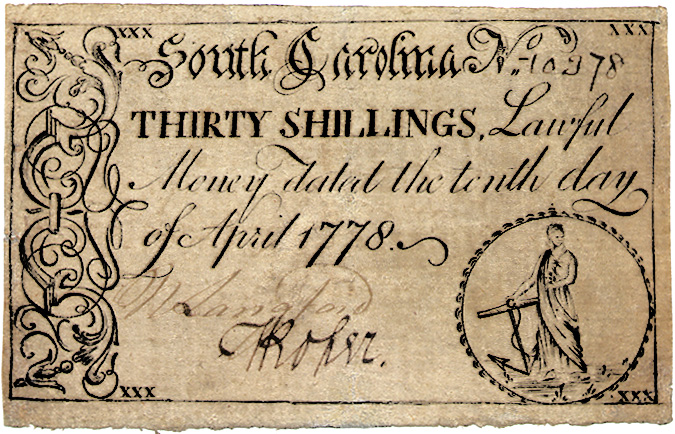
Nicholas Langford 1778 South Carolina Currency
v 
30s Serial Number: 10,378 SC 04/10/78
Signers: Nicholas Langford, William Roper.
Size: 62 x 96mm. (obverse border design 56 x 93mm).
Comments: Seal depicts a personification of Hope holding a branch in her left hand and with her right hand resting on an anchor. Click here to view the blank back.
Provenance: EANA mail bid auction 04/26/97 lot 329. Purchased through the Robert H. Gore, Jr. Numismatic Endowment.
30s Serial Number: 10,378 SC 04/10/78
Signers: Nicholas Langford, William Roper.
Size: 62 x 96mm. (obverse border design 56 x 93mm).
Comments: Seal depicts a personification of Hope holding a branch in her left hand and with her right hand resting on an anchor. Click here to view the blank back.
Provenance: EANA mail bid auction 04/26/97 lot 329. Purchased through the Robert H. Gore, Jr. Numismatic Endowment.
Thomas A. Langford Obituary
CAMPAIGN NEWS 2000
Former Provost and Divinity School Dean Thomas Langford Dies
Former Provost and Divinity School Dean Thomas Langford Dies
From the Duke News Service
February 13, 2000

As an administrator, Langford led Duke through an important period of change. He guided the Divinity School through a time of growth, and as provost, he helped the university respond to a series of tight budgets caused in part by declining government support, escalating capital and technology costs and an increasing need for financial aid.
As a scholar, Langford received attention for his books and articles on British theology and philosophical theology.
Duke President Nannerl O. Keohane on Sunday said Langford was "a wonderful colleague, advisor and friend. He was truly one of the wisest and most thoughtful people I've ever known. He was much beloved by many generations of Duke students and he will be greatly missed."
Keohane became Duke president while Langford was provost, and she said he was a "most amazing mentor, advisor and guide. I relied enormously on his judgment, what we should focus on as we set our priorities. I was very fortunate that he was in the provost's office when I got to Duke. At that point, he was my closest colleague."
Langford's tenure at Duke touched nearly every aspect of the university community. He received his B.D. from Duke Divinity School in 1954 and his Ph.D. from Duke as well in 1958. He joined the faculty in 1956, teaching in both the department of religion, where he served as chair, and in the Divinity School. From 1971-1981, he served as Divinity School dean.
In 1984, he became vice provost for academic affairs under Provost Phillip Griffiths. When Griffiths took a sabbatical for most of 1990, Langford stepped in as interim provost. He assumed the position full time when Griffiths became director of the Institute for Advanced Study in 1991.
During Langford's tenure as provost, the university passed a number of milestones: Duke began to map out plans for an improved planning process; the university-wide budget formula continued to be revised to enhance budget planning; a new initiative involved the entire campus in recruiting black faculty and students to campus; the Center for Teaching and Learning was formed to assist faculty and graduate student teachers with teaching skills; and Keohane became Duke's eighth president. He stepped down as provost in 1994 to return to the classroom.
While the time of tight budgets started under Griffiths, it was during Langford's term as provost that the university most seriously faced decisions related to limited resources. Richard Burton, the former chair of Duke's Academic Council, once said he thought Langford had a knack for identifying the core programs of the university.
"His intention [when faced with conflicting budget pressures] was always to ask what was right for the university," said Burton, a professor in Duke's Fuqua School of Business. "He felt that the reason why we were here was for scholarship, teaching and research. He never lost that; you might say he kept his 'eyes on the prize.' When dealing with limited resources, this is important. He was always guided by his internal compass of what was the university's mission."
As a teacher, Langford was a winner of one of the first teaching awards presented by the Duke student government. When Langford retired as a Divinity School professor in 1997, Divinity Dean L. Gregory Jones said, "Tom Langford has had an extraordinary career and unparalleled influence as a teacher, scholar and administrator. He has made enormously significant contributions to the United Methodist Church, to theological education and to Duke University. Tom embodies a rare contribution: a keen and searching intellect, astute judgment, faithful service, exemplary character, and a gracious spirit. A master teacher, he has influenced generations of students at Duke."
Langford served on many university committees on issues as varied as student life, black studies and Duke Press. After retiring in 1997, he served as William Kellon Quick professor emeritus of theology and Methodist studies and continued writing on Methodist theology. He also was active in the local community and in the church. An ordained United Methodist minister, Langford loved the church, Jones said on Sunday. "He played a key role helping United Methodism maintain theological continuity with its origins," Jones said.
He also served on the Board of Trustees of The Duke Endowment, the Charlotte-based philanthropic organization, and chaired the board's Rural Church Division. He exercised leadership in developing new ways in which that foundation's resources could be used to enhance churches, universities, health-care institutions, children's homes and communities throughout North and South Carolina.
Langford delivered the eulogy in April 1998 at the funeral service for his longtime friend, Terry Sanford. The two men met in 1960 when Sanford was successfully running for governor, and they went on to develop a friendship that lasted more than a quarter century. The friendship between Sanford and Langford began as a working relationship in 1968 when Langford served on the search committee that recommended Sanford to Duke's Board of Trustees, leading to his installation as the university's sixth president.
Shortly after Sanford was diagnosed with inoperable cancer, he himself asked Langford to give the eulogy.
"I think Terry asked me to give the eulogy because he saw himself as a churchman, as someone active in the life of the church," Langford said prior to Sanford's funeral. "He was indeed very active in the church, and I am honored to speak in his memory."
In presenting Langford in 1998 with the University Medal for Distinguished Meritorious Service for decades of service to Duke, Keohane said, "Here is a man whose intellectual depth and range have invigorated the field of philosophical theology, whose religious faith has expressed itself in service to the church and the community, whose caring disposition has made him a revered colleague and a valued mentor, whose steadfastness has impressed those who have observed his administrative adeptness, and whose loyalty over more than 40 years has helped to shape this university."
Langford's "lasting influence can be found in the many scholars and students whose lives he has touched," Keohane added in her 1998 presentation. "[Divinity Dean Jones] says he hears account after account, from alumni across the generations, of how the class taught by [Langford] was their favorite at Duke. 'His power as a teacher and a preacher is embodied in his own gracious spirit. He is consistently attentive to others and their concerns, offering reflections in ways designed to make others — and in his administrative service, Duke University — better.'"
Langford is survived by his wife, Ann Marie Daniel Langford, their four sons and their families. A memorial service will be held at 3 p.m. Friday, Feb. 18, at Duke Chapel.
Sunday, May 06, 2007
Glouster County Virginia
John Langford transported by William Hampton
GLOUCESTER COUNTY, VA - DEEDS - William Hampton,
25 Mar 1651
  ----¤¤¤----

Citation:
Patent Book No. 2
1643-1651
Page 311
William Hampton

To all etc. whoever etc Now Know yee that I the said
Sr. Wm. Berkeley etc.give and grant unto William Hampton
seven hundred acres of land lyeing on the East side of
the Eastern most river in Mockjack Bay begining on the
South side of a Creeke at a marked tree and running East
by North three hundred and twenty poles South by East
three hundred and fifty poles west by South three hundred
and twenty poles and North by west three hundred and fifty
poles to the river by the aforesaid Marked tree, the said
Land being due unto the said William Hampton by and for the
transportation of fourteen persons into the Colony etc. to
have and to hold etc. which payment if to be Made Seven years
after the first grant or Sealing thereof and not before etc.
Dated the 25th of March 1651

Thomas Smith Jeremy Edes  Wm. Galoman John Wattkins
Richard Cary  Philad: Hampton        Wm Davis
Hugh Bromly John Ash            Lymon Vaughan Ailce Walker
Wm. Bozeman    John Langford           Wm. Bozeman

Submitter Note: The above is translated from the early script of the
Colony of Virginia and spelling is retained as in the original document.

Copyright 2004 by Poldi J. Tonin
Friday, May 04, 2007
LANGFORD AND PROCTOR of Salem Massachusetts
Subject: | Langford and Proctor in Salem Massachusetts | Type: HTML Msg |
A History of Salem Massachusetts
By Sidney Perley
Volume I
1626-1637
Salem, Mass.
Sidney Perley
1924
| << | p1-357 | < | > |

Wednesday, April 18, 2007
William D. and Manoah L. Langford of Louisa Co. VA
Louisa County Virginia Deed Records
Book: CC, Page: 406, Grantor: John R. Hopkins, Grantee: William D. and Manoah L. Langford, Date: 30-Mar-1853
Deed 30 Mar 1853 John R. Hopkins of Louisa atty for Elizabeth D. and Mary E. Gooding of Marion Co., Ohio to William D. and Manoah L. Langford of Louisa $1,083.45; parcel of land bequeath to Elizabeth and Mary Gooding by Paul Wayate, Dec., cont 155 acres adjoining Caroline M. Langford and others Sig. John r. Hopkins Rec. 6 Jun 1853
NOTE: Louisa County VA 1850 federal census Series M432 Roll 957 Page 424 , Household 970
Caroline Langford, age 58
William D., age 39 Teacher
Manoah, age 31 Asst. Farmer
Angelina, age 25
Book: CC, Page: 406, Grantor: John R. Hopkins, Grantee: William D. and Manoah L. Langford, Date: 30-Mar-1853
Deed 30 Mar 1853 John R. Hopkins of Louisa atty for Elizabeth D. and Mary E. Gooding of Marion Co., Ohio to William D. and Manoah L. Langford of Louisa $1,083.45; parcel of land bequeath to Elizabeth and Mary Gooding by Paul Wayate, Dec., cont 155 acres adjoining Caroline M. Langford and others Sig. John r. Hopkins Rec. 6 Jun 1853
NOTE: Louisa County VA 1850 federal census Series M432 Roll 957 Page 424 , Household 970
Caroline Langford, age 58
William D., age 39 Teacher
Manoah, age 31 Asst. Farmer
Angelina, age 25
Saturday, March 10, 2007
Butler Family Cemetry Funding by Kentucky
Percival Butler married Mildred Hawkins the daughter of Mary Langford and John Hawkins of Hanover County Virginia. Mary is reported to be the daughter of Thomas Langford. The Langford name continues through this family, i.e, Joseph Langford Hawkins, Thomas Langford Butler.
Governor's Office for Local Development
Governor Fletcher Approves Funding for the Butler Family Cemetery
| Press Release Date: | Tuesday, April 25, 2006 |
| Contact Information: | Samantha Cook Public Information Officer 1-800-346-5606 |
Governor Ernie Fletcher and the Governor’s Office for Local Development (GOLD) today announced a $25,000 Cemetery Preservation Fund grant for the General State Resort Park Family Cemetery located at the Butler-Turpin State Historic House.
“All cemeteries have very special connections to our past and certainly the Butler
Cemetery Preservation Funds will be used for initial cleanup, landscaping, fencing, equipment purchases, signage, tombstone repairs and cleaning, surveillance cameras and historical research.
Senator Ernie Harris (R-Crestwood) said, “Each year, hundreds of people visit the Butler-Turpin Historic House. The improvements at the cemetery will enhance their visit and provide them with an even better grasp of the history of the facility.”
The
"The historical and archeological research connected to this park is important for
The Kentucky Cemetery Preservation program funds maintenance, preservation and restoration activities. Examples of maintenance activities include initial cleanup and landscaping, purchasing equipment, fencing, signage and improving interior roads. Preservation and restoration activities include acquiring conservation easements, surveying boundaries and repairing and cleaning tombstones.
Other activities that are eligible for funding are historic research, archiving, training to support cemetery preservation and improving access roads.
Counties may establish five-member county cemetery boards to apply for grants. State agencies, local governments, and certain nonprofit organizations – cemeteries, historical and genealogical groups, and local civic groups – also may apply. However, applications from county boards will receive funding priority.
The maximum grant that a group can receive is $25,000 and the minimum grant is $1,000, and a one-to-one local match is required.
A five-member state board oversees the program and makes funding decisions. The state board is chaired by the Commissioner of GOLD and also represents the Kentucky Heritage Council, the Kentucky Historical Society, the Kentucky Association of Counties and the Kentucky African-American Heritage Commission.
Friday, February 16, 2007
Thomas Lankford-Louisa County Virginia 1746-48
23 Sep 1746
Louisa Co., Virginia Court Case: Thomas LANKFORD against John CONSOLVER In Case Dismist.
(source: Louisa Co., Virginia Orders 1744-1748, Antient Press)
021404v1_LKH
26 Apr 1748
Louisa Co., Virginia Court Case: Thomas LANKFORD against John CONSOLVER
This day came the Plt. by his attorney and the Deft. being returned arrested solemnly called came not; therefore it is ordered that unless the Deft. shall appear at the next Court and answer the Plt.'s action, Judgement shall be entered for the Plt. against him for what shall appear due with costs.
(source: Louisa Co., Virginia Orders 1744-1748, Antient Press)
021404v2_LKH
28 Jun 1748
Louisa Co., Virginia Court Case: Thomas LANKFORD against John CONSALVER
This day came as well the Plt. by his Attorney as the deft. in his proper person and the deft. confesseth the Plt's action for 9 pounds, nineteen shillings current money therefore it is considered by the court that Plt. recover the same against the Defendt. together with his costs by him in this behalf expended and the defendt. in mercy & c.
(source: Louisa Co., Virginia Orders 1744-1748, Antient Press)
021404v2_LKH
Louisa Co., Virginia Court Case: Thomas LANKFORD against John CONSOLVER was dismissed.
(source: Louisa Co., Virginia Orders 1744-1748, Antient Press)
Saturday, February 03, 2007
Stephen Langford Gravesite Found
In Search of Stephen's Grave
The date for the reunion was set. Invitations had been sent. Response was encouraging. RSVP's were pouring in from all across the country. Only one thing was missing .....The Guest of Honor himself.
In the nearly 200 years since his death in 1811, the exact location of Stephen Langford's grave had been lost. There were rumors, based on recollections, that were more than half a century old. Family legend said that he was buried in Rockcastle very near the site of Langford Station, that tavern on the Wilderness Road where he supplied immigrants to Kentucky with food, a bed to sleep in, protection from Indian attack, and perhaps a little rum to ward off an autumn chill.
But rumor was all that could be had concerning this pioneer's grave, until... Saturday, February 27, 2007, when Research Historian, Jeff Renner, visited the old Elmwood Cemetery in Mt. Vernon, Kentucky. Here in Jeff's own words is what he discovered:
"I found Stephen's stone. It is indeed in Elmwood Cemetery, just very, very hard to read. I caught a glimpse of what I thought was "TEP" on one of the old stones, so I got some flour and used it to bring out the detail. There's no question it says....
"IN MEMORY OF STEPHEN LANGFORD". (For the name especially, see the attached computer- enhanced photo.)
There are no dates or other information on the stone, nor any indication there ever was. he stone is broken roughly in half. It's in the oldest section of the cemetery. There are no marked graves close on either side of it.
The red arrows in the attached "elmwood1.jpg" and "elmwood2.jpg" photos show the relative location of the stone.
The stone does not appear to be the type that was stuck vertically in the ground. The beveled edge seen in the photo goes all around the edge. I would guess this was the top cap stone of a sarcophagus-like monument, similar to those seen in the attached " williamsmith.jpg" photo (that one was taken in 1911 and is of William Smith and his wife; the location is shown by the green arrow in elmwood2). The structure was probably not exactly the same, as the Smith monument tops lacked the bevel and were thicker.
The Langford stone is very similar in size and thickness to the ones of Mary Lewis (foreground of elmwood2), Mar? Carson (laying right of the bush and tree stump in front of Langford in elmwood1.jpg), and a couple of other early markers in the cemetery, and has the same bevel. The Lewis marker has several of what looks to be the remains of the support stones underneath it. There are only a few such stones under the Langford marker. The large vertical marker in the center of elmwood1 is Joseph Carson, who died in 1815." ......Jeff
There are many strange coincidences in life. How odd that Stephen's stone should be discovered in 2007, the very year that The First Annual Stephen Langford Memorial Reunion takes place.
Join us in Mt. Vernon, Ky on May 27. You won't want to miss Jeff Renner's description of life in early Kentucky along the Wilderness Road. Food, fun, and fellowship are also on the agenda. Be there because...
It Simply Won't Be The Same Without You!
The Stephen Langford Memorial Reunion Staff


Saturday, January 13, 2007
LANGFORD and LANKFORD of GEORGIA
Will Book A (1813-1841) Madison County Georgia
Page 1 ~ John Thompson
29 Oct 1811
To my younger brother William Thompson, my part (which is the half) of the land on which we now live, consisting of Mills, Distillery & Cotton Machine, Waggon & Harness. Balance of property consisting of 4 Negroes, lands, stock, household and Kitchen furniture to be divided equally between my brothers and sisters, Viz: James Thompson, Sarah Robbinson, Ruth Strickland, Alexander Thompson, Esther Langford, Robert Thompson, & William Thompson. Exec: Alexander and William Thompson. Signed: John Thompson. Witness: John Mayes, James Ramsey. Rec'd: 12 Mar 1813. William Sanders, CCO.
Will Book B, Madison County Georgia
October 1882
To my beloved wife Malinda Collins, the companion of my bosom and the partner of my joy and of my sorrows, for and during her natural life, the tract of land on which I now live known as my home place, with all the improvements and appurtenances, together with the tract or little parcel which I purchased from W. J. Burgess and the little parcel I purchased from H. F. Davis, also the town tract and the Burroughs tract, all lying adjacent to my home tract. I also give my wife for and during her natural life all my household and kitchen furniture, four mules to be selected by herself, also two cows and calves, and ten head of hogs. All the property real and personal mentioned I give to my wife for life, it being understood that my son Joab T. shall live with my wife, --- the farm, take care of the property, kindly and affectionately treat his mother, support and maintain both my self and my wife so long as we both shall live, and in all particulars continue as he has been a dutiful, kind and affectionate son. And in consideration that my son Joab T. is to live with, support, maintain and kindly treat both myself and my wife during our lives, it is my will and desire that all the property herein before bequeathed to my wife for life shall at her death become the property of my beloved son Joab T. Collins. To my daughter Harriett F. Thornton, in addition to what I have heretofore given her, the sum of $500 in cash. To my daughter Margaret M. Hawks, in addition to what I have heretofore given her, the sum of $500 in cash. To my son Joab T. Collins in trust for the use and enjoyment of my daughter in law Ellen Collins and my grandchild Minnie Collins, the wife and child of my son James Willis Collins, and any future wife and child or children of my son James Willis Collins, the following property, to wit, a tract of land known as my Rice tract, and that part of Christian tract which I yet own, and also that part of the Shoemaker tract which I yet own, said property to be held in trust for the use and benefit of the wife and children of J. W. Collins until his youngest child becomes 21, and then the title to this property shall rest absolutely in the children of J. W. Collins if J. W. Collins is not in life, but if in life then title to rest with in J. W. Collins jointly. To my son Joab T. Collins, the tract of land known as my Bill Place or Mill tract, also my Wilhite tract and my Deadwyler tract. To my beloved daughter Huldah P. Langford, for and during her natural life, the following property, to wit, my Roland Brown tract, my Griffith tract, and my Miller tract, to remain her property during her life and at her death to become the property of her children. The children of those deceased shall stand instead of the deceased parent. If there be in my will apparent differences made between my children, my reason for the differences is their difference in treatment which I have received from them. I have given to my daughter Harriett F. 200 acres of land heretofore and to Margaret M. $800 in money heretofore. My property not herein before specifically mentioned and disposed of to be sold and applied to the payment of any debts and expenses that may arise from my death and burial, and to the payment of the two cash legacies bequeathed to my daughters. Executor: my son Joab T. Collins. Signed: Elbu Collins. Witness: Isaac Strickland, J. T. Adams, Henry David, J. B. Estes. Rec’d Nov 1882.
Tuesday, January 09, 2007
Stephen Langford Memorial Reunion
Hear ye, Hear ye, Hear ye!
Announcing The First Annual
Stephen Langford Memorial Reunion
To be held Sunday, May 27, 2007 from 1 to 5 p.m.
at the pavilion of the Bible Baptist Church in Mt. Vernon, Kentucky
In 1782, Stephen Langford, first benefactor of Mt. Vernon, followed the Wilderness Trail into Kentucky. In 2007, you are invited to join us as we retrace his amazing journey and meet a hundred or so of his descendants.
Activities will include a discussion of Langford and local history by research historian, Jeff Renner, some amazing door prizes with an "authentic" historical "twist", a chance to meet and greet local dignitaries, a presentation of the town's plans for a memorial to Stephen Langford and a chance to see an authentic Kentucky Long Rifle, circa 1830, hand crafted by Stephen Langford's grandson, Lick Creek Stephen.
This celebration is for anyone with Langford roots in Ky. It's for all friends of the Langford family. It's for anyone interested in Langford history in general. It's for anyone with connections to Rockcastle County or for those who only wish they did!
Look for continuing updates with additional information as plans unfold, including directions to the gathering place and a list of accommodations in the Mt. Vernon area. In the meantime, please contact Shiron at shiron@gvtc.com with any questions.
Remember, Mt. Vernon is the home of the famous Renfro Valley Barn Dance with shows every Sat night, so make your reservations well in advance.
Put the date May 27 on your calendar. Make your travel plans TODAY!
Be there or be square!
Sunday, January 07, 2007
Euclid Langford - Valley Forge - Revolutionary War

| Personal ID: | VA05620 |
| Last Name: | Langford | First Name: | Euclid | Suffix: |
| Rank: | PRIVATE | Rank Type: | RANK AND FILE | Ethnicity: | |
| Brigade: | 1ST VA BRIGADE | Company: | MERIWETHER |
| State: | VA | Regiment: | 1 VA | Division: | 5TH DIVISION |
Monthly Muster Roll Status
| December 1777: | |
| January 1778: | |
| February 1778: | |
| March 1778: | |
| April 1778: | |
| May 1778: | |
| June 1778: |
Additional Remarks (if any):
| ALSO DESIGNATED SHIELD'S CO. |
Saturday, January 06, 2007
John Langford Land Grant 1731 Henrico County Virginia
John Langford, 300 acres. (Lapsed Land), Henrico County on West side of Uffnam Brook, 22 February 1731, page 363, Patent Book 14. Granted to Richard Mosby, 10 February 1725, on condition of seating and etc. John Bacon, Gent., of New Kent County obtained grant for same which he made over to said Langford, now granted and etc. 30 Shillings.
Land History:
Richard Mosby, 300 acres (New Land), Henrico County on west sie of Uffnam Brook, 19 February 1725, page 339, Patent Book 13, page 339. 30 Shillings.
John Bacon of NewKent County, 1600 acres (Old and New Land), Henrico County, beginning on Ufnam Brook, parting his own and land of John Watson, down said Brook to the mouth of where it falls into the Chickahominy River or Sw. adj. Thomas Owen; 13 October 1727, page 282, [ and description continuing.] Paid 3 Lbs. Money.
Land History:
Richard Mosby, 300 acres (New Land), Henrico County on west sie of Uffnam Brook, 19 February 1725, page 339, Patent Book 13, page 339. 30 Shillings.
John Bacon of NewKent County, 1600 acres (Old and New Land), Henrico County, beginning on Ufnam Brook, parting his own and land of John Watson, down said Brook to the mouth of where it falls into the Chickahominy River or Sw. adj. Thomas Owen; 13 October 1727, page 282, [ and description continuing.] Paid 3 Lbs. Money.
Subscribe to:
Posts (Atom)